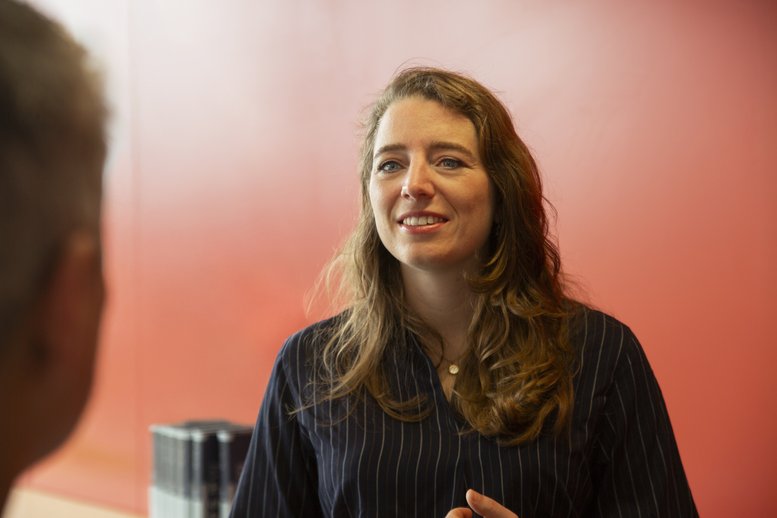
Portrait of Sanne Vrijenhoek, tenure tracker in the Human-Centered Data Analytics group

Translating societal issues back into technology: that is Sanne Vrijenhoek’s core business. Her work focuses on artificial intelligence (AI). At CWI’s HCDA group, she studies systems that recommend news articles — the kind of feature on a news website that suggests more stories at the bottom of a page that might also be of interest.

After completing her university degree in AI at Vrije Universiteit Amsterdam, Sanne started out in the commercial sector, but quickly realised it was not for her. “Then I came across the vaguest job advert ever on LinkedIn,” she says with a smile. “It was at the University of Amsterdam’s Faculty of Law, with Natali Helberger. She had certain ideas about the role news recommender systems can play in everyday life. She was looking for someone with a technical background who could help shape such a system. It was not a PhD position, and it was unclear whether it would even lead to a publication.”

Cat videos

What was meant to be a one-year position turned into a seven-year project, ultimately culminating in a PhD after all. “And then this position at CWI came up. What I do is translate communication science and journalism into a design, into the way we want technology to behave.”

By that, the researcher does not mean that if you like watching cat videos, the system should simply offer you more cat videos. Sanne is interested in something more fundamental: not what you want to see, but what you should see if you want to understand what is happening in the world. “No clickbait, no filter bubble, but an introduction to other perspectives, to things you do not yet know. That is what my research is about: how do people become informed?”

Not in a vacuum

In her research, Sanne likes to look beyond the boundaries of both her group and her discipline. After all, what is the point of a group of technologists designing a system together if it is of no use to the people who are meant to use it? “Computers and computer science do not exist in a vacuum; they have a function in society. Making an algorithm just a little faster, or slightly better at predicting interests, is not what I find most interesting. What matters to me is how it is applied.”
“There is a great need for people who can bridge technology and major societal issues, because AI is having an ever greater impact on everyday life.” So far, she says, there are still relatively few women in that space. Back when she studied AI, there were only a handful. Before joining the law faculty, she was often the only woman in work meetings. “I remember a meeting with Natali where, for the first time, everyone in the room was a woman. That really stood out.”

More diversity

Sanne believes it is important to draw more girls - as well as people from other underrepresented groups - into computer science. “We cannot steer the development of AI in the right direction if, structurally, only a small and homogeneous group is in control. That means our field has work to do to become a welcoming place for women, but also for queer people, people of colour, and everyone else who does not fit the standard image of a tech person. The responsibility to take the first step lies with us; we cannot wait for them to come to us of their own accord. And we also need to look more carefully at the role the so-called ‘soft’ disciplines can play in the further development of technology.”

A technical profile

The fact that she did not fit the stereotypical image of a tech person has never stopped Sanne from pursuing what she wanted to achieve. “My family does not care much for convention. I tend to do precisely what is not expected of me. I think girls are often encouraged to choose something familiar, rather than venture off the beaten track. But in the end, you have to do what you enjoy.”

Portret Sanne Vrijenhoek

International Girls in ICT Day

On 23 April 2026, International Girls in ICT Day draws worldwide attention to girls and young women in technology. It encourages them to develop digital skills and consider studies and careers in ICT. At CWI, we are marking the day by featuring two female researchers and their work.

Read the story of Effy Li, postdoc at the Database Architectures group.