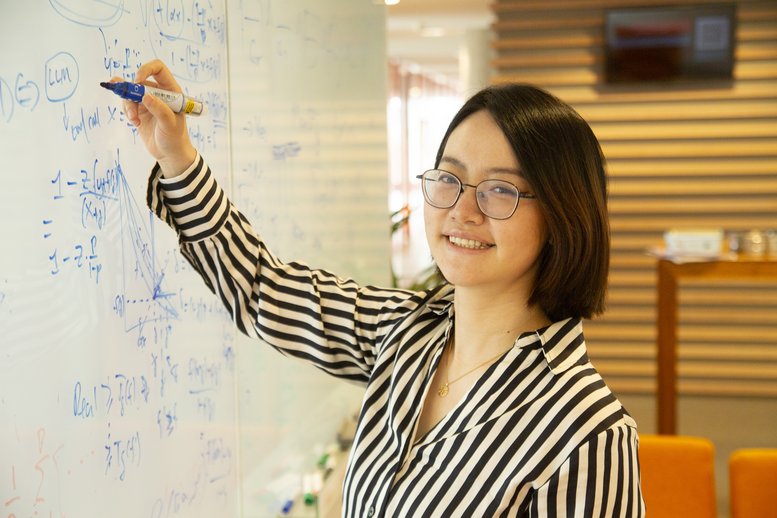
After her Master’s, Effy joined Microsoft Research in Cambridge as an AI Resident, where she worked on turning research ideas into prototypes. Yet it was the research itself that appealed to her most. She began looking for a place to pursue a PhD, and found it at the University of Amsterdam, where she was introduced to data management. That eventually led her to CWI’s Database Architectures group, where she now works as a postdoc. Currently she focuses on making data science systems better at using existing knowledge. “My initial idea of what I wanted ten years ago was completely different from what I eventually ended up doing,” she reflects.
Gender imbalance
One constant throughout her journey was mathematics. It also led Effy into a field still largely dominated by men. “During my Bachelor’s, only twelve out of 122 students were women. Because there were so few female students, I felt I had to work even harder. Another experience from that period also made a profound impression on me. I was part of a team entering a competition, and one of the team members complained about having a girl in the group. That made me even more determined to prove myself. I worked incredibly hard — sometimes even sleeping in the lab. In the end, our team won multiple competitions, and I became the team captain.”
These experiences stayed with her. During her Master’s, Effy began to reflect more consciously on the gender imbalance around her. “Part of me had always wanted to help improve society, and I would like to be a source of inspiration for other women in STEM,” she says, referring to science, technology, engineering and mathematics. “I strongly believe that female students are less likely to apply to a programme if they see very few women in it.”
All-women committee
During her PhD, Effy saw examples of how that imbalance can be changed. Her supervisor actively tried to build a more balanced group. “When we were putting together the committee for my PhD defence, we said to each other: ‘how cool would it be to have an all-women committee?’ We almost succeeded: out of the five members, only one was a man.”
Effy believes things are changing. Progress may be gradual, but it is visible. “If I compare my experiences during my Bachelor’s in 2012-2016 with the situation now, I can see that people are more open to gender issues.”