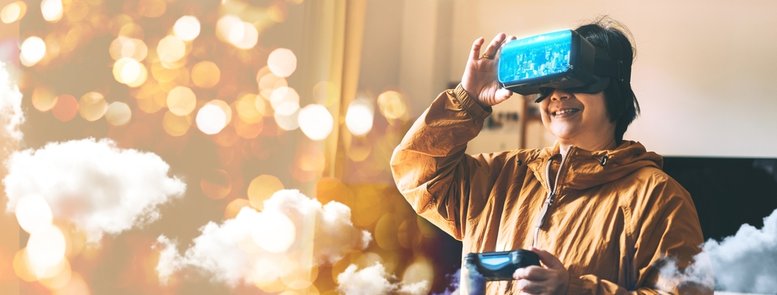
Using social XR to improve mental health, or to help young people develop social skills, is still an emerging field. “There is very little research on this,” says Alexandra Kitson, a researcher at the VIXI Lab at the University of Victoria. Her work focuses on the design, development and evaluation of emerging technologies, including XR, AI and wearable systems, to support health and wellbeing.

Kitson’s route into VR research began with a broad academic background in computer science, philosophy, psychology and linguistics, combined with volunteer work for a crisis and suicide hotline. That combination led her to explore how VR could support mental health. “Our focus is on improving the wellbeing of young people through smart devices or wearables. I collaborate with psychologists and therapists, who often do not yet know how to use these technologies to support their patients.”
How can XR technology improve mental health and wellbeing?
“Social VR platforms already allow people to meet, play and create shared environments. If designed with clear rules around safety, age and consent, such spaces could offer support to people who feel isolated or have very few social contacts. For people with social anxiety, depression or other mental health issues, VR can offer a way to connect with others, rebuild confidence and access support without having to leave home. An example of this is VRChat, where anyone can create a virtual environment and others can join.
One existing application is exposure therapy in a virtual environment. Some apps have been developed specifically for this purpose. For instance, a calming virtual environment, such as a forest or a stream, where people can focus on exercises that support emotional wellbeing. Other spaces are designed for social interaction, with behavioural rules, events and time with an actual therapist.
In one study I've seen from Yale University, teenagers practised situations such as arriving at a party where they did not know anyone, starting a conversation, or saying no to vaping. VR allowed them to try different strategies in a safe environment.”
Therapies like exposure therapy already exist outside virtual worlds. Why use XR?
“VR can strengthen existing therapies by making difficult situations feel more real, while still allowing people to practise them in a controlled and relatively safe space.
In Canada, we also have a mental health crisis, with long waiting lists. In some cases, people may wait two years before they can see a therapist. VR could be a way to help prevent mental health problems by allowing people to practise skills that make them more resilient in daily life. People do not always want to practise these things at school. But in VR, it can be more engaging and more fun.”
Which strategies look promising in XR?
“In behavioural therapy, cognitive reappraisal is a proven method. It helps people look at a difficult situation differently, especially when they cannot change the situation itself. For young people, this can be hard to learn. XR, combined with AI and Large Language Models, could help them practise to reframe an unhelpful thought. For example, someone who panics about failing an exam may quickly imagine the worst: failing the course, not finding a job, or even ending up homeless.
In VR, we can play out that situation and help them explore other responses. What if they ask for help, or study together with a friend? In this way, they can practise reframing their thoughts in a safe environment.”
What are the challenges?
“Some technological advances are still needed. If several people are in the same virtual space, you do not want delays, or environments that fail to evoke a real emotional response. That also requires technologies that allow people to experience touch in VR and have a better sense of their own body for example by physiological sensing. These technologies still need to be integrated more effectively.
But the biggest challenge for me is designing online spaces that can support people with mental health issues in a way that does more good than harm.”
Where do you hope your research will be in ten years?
“I hope we will have figured out social norms that people can broadly agree on: norms that are ethically sound and that make these spaces safer. Also, we need augmented reality glasses, headsets, smartwatches and headphones to become better integrated, so that we are not glued to our computers and these technologies can become part of daily life.
Most of all, I hope people will have the right to choose whether they use these technologies, without being excluded when they choose not to use them.”
Header photo: Minnie Middelberg