
Inria-CWI

Inria-CWI is a Franco-Dutch cooperation in digital science and technology.

About Inria

Inria is the French national research institute for digital science and technology. World-class research, technological innovation and entrepreneurial ambition are at the heart of its mission. Across 215 project teams, most of which are run jointly with leading research universities, more than 3,900 researchers and engineers explore new research directions. They often work across disciplines and collaborate with industry to address complex challenges.
As a technological institute, Inria supports a wide range of innovation pathways, from publishing open-source software to creating deep-tech start-ups.

A long-term reliable partnership

CWI and Inria have worked together successfully for several decades and have established a strong relationship as reliable partners. Both institutes have an international reputation for high-quality research in mathematics and computer science and for addressing societally relevant questions.
By strengthening the cooperation with a partnership agreement,

the institutes aim to join forces and intensify their collaboration within the international research community. Together, they seek to advance scientific research and develop joint proposals for EU-funded projects.

CWI and Inria have also established a joint Inria International Lab (IIL). These laboratories are designed to support and develop long-term research partnerships with leading institutions around the world.

Intensification of the collaboration
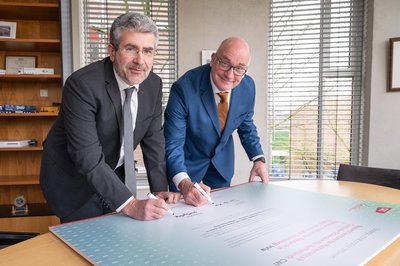
Institute managers Bruno Sportisse and Ton de Kok signing the agreement in 2023.

In April 2023, in the presence of French Minister Sylvie Retailleau and Dutch Minister Robbert Dijkgraaf, Inria and CWI signed an agreement to extend their cooperation in quantum computing, human–computer interaction, energy, cryptography, digital health, machine learning and software engineering.

Collaboration in these areas is intended to contribute to a united and inclusive digital Europe, strengthening Europe’s technological sovereignty while addressing societal challenges.

Associate Teams

Inria’s Associate Teams programme is one of its key instruments for supporting international collaborations. CWI is currently involved in several ongoing research projects within this programme.

Associate Teams in 2026

Principal investigators
Benoit Combemale, DiverSE research team, Inria
Tijs van der Storm, Software Analysis and Transformation group, CWI & University of Groningen

Abstract
Software engineering faces new challenges with the advent of modern software-intensive systems such as complex critical embedded systems, cyber-physical systems and the Internet of things. Application domains range from robotics, transportation systems, defense to home automation, smart cities, and energy management, among others. Software is more and more pervasive, integrated into large and distributed systems, and dynamically adaptable in response to a complex and open environment. As a major consequence, the engineering of such systems involves multiple stakeholders, each with some form of domain-specific knowledge, and with an increasingly use of software as an integration layer. Hence more and more organizations are adopting Domain Specific Languages (DSLs) to allow domain experts to express solutions directly in terms of relevant domain concepts. This new trend raises new challenges about designing DSLs, evolving a set of DSLs and coordinating the use of multiple DSLs for both DSL designers and DSL users. ALE will contribute to the field of Software Language Engineering, aiming to provide more agility to both language designers and language users. The main objective is twofold. First, we aim to help language designers to leverage previous DSL implementation efforts by reusing and combining existing language modules. Second, we aim to provide more flexibility to language users by ensuring interoperability between different DSLs and offering live feedback about how the model or program behaves while it is being edited (aka. live programming/modeling)..

Website: http://gemoc.org/ale/
Keywords: Software Engineering, Domain-Specific Language, Language Design and Implementation, Live Programming

Principal investigators
Oana-Denisa Balalau, CEDAR research team, Inria
Davide Ceolin, Human-Centered Data Analytics group, CWI

Abstract
From recommender systems to large language models, data-driven AI tools have shown different forms of limitations and bias. Bias in AI tools may stem from multiple factors, including bias in the input data the AI tools are trained on, the algorithm and the individuals responsible for designing the AI tools, and bias in the evaluation and interpretation of AI tool outputs. Limitations are due to technical difficulties in achieving specific tasks. Media outlets use different algorithmic aids in their workflow: keyword extraction, entities and relations extractions, event extraction, sentiment analysis, automatic summarization, newsworthy story detection, semi-automatic production of news using text generation models, and search, among others. Given the importance of the media sector for our democracies, shortcomings in the tools they use could have severe consequences. Both Inria and CWI have partnerships with large media groups and can help them address bias and limitations in their AI workflows.

Website: under construction

Keywords: Natural language processing Machine learning and statistics Data and knowledge analysis Participative democracy Information systems

Principal investigators
Frédéric Alexandre, MNEMOSYNE research team, Inria 
Sander Bohte, Machine Learning group, CWI (The Netherlands) 

Abstract
Metacognition is the process by which, instead of just learning to associate a response or a behavior to a situation, animals (and mainly primates) monitor the functioning (and particulary errors) of these simple cognitive processes and learn to inhibit automatic responses and to promote instead contextually appropriate behavioral rules. The main learning algorithms classically used in Artificial Intelligence (supervised learning and reinforcement learning) correspond to simple cognitive processes. A large amount of work (including ours) have shown a general structural equivalence between classical and bio-inspired Machine Learning on these topics. Nevertheless, the divergence between algorithms in Artificial Intelligence and Computational Neuroscience is much more important, when we consider metacognition. This motivates the need for preparing future bio-inspired models of metacognition for Artificial Intelligence, in addition to their intrinsic interest for brain sciences, as we propose in this Associate Team.

Keywords: Artificial Intelligence, computational neuroscience, metacognition, Machine Learning

Website : in progress

Principal investigators
Tommaso Taddei, MEMPHIS research team, Inria
Benjamin Sanderse, Scientific Computing group, CWI

Abstract
Model order reduction (MOR) of parametric PDEs is a well-established field in scientific computing that aims to reduce the marginal cost associated with the solution to parametric systems: MOR is motivated by many-query (optimization, parameter sweeps) and real-time (interactive design, monitoring) applications, which naturally arise in the field of continuum mechanics. Despite the numerous examples of applications of MOR to large-scale industrial problems, the practical deployment of MOR techniques remains limited in computational fluid dynamics (CFD). To address the current limitations of MOR methods, several authors have proposed structure-preserving projection techniques and nonlinear data compression methods: the former refer to a class of methods that aim to preserve notable properties (e.g., positivity, entropy conservation) of the solution to the underlying PDE, which are not necessarily guaranteed at the reduced-order level; the latter refer to a class of methods that exploit a nonlinear ansatz to estimate the state field. The objective of the Associate Team SPADES between Inria Team MEMPHIS (PI: Tommaso Taddei) and CWI (PI: Benjamin Sanderse) is to devise effective structure-preserving nonlinear model reduction techniques for unsteady nonlinear PDEs that arise in computational fluid dynamics (CFD). The project benefits from the very complementary expertise in nonlinear approximation methods and structure-preserving reduced-order formulations of the two partners, and has the potential to address the grand challenges of model reduction techniques for a broad range of applications in CFD.

Website: under construction

Keywords: Model order reduction; structure preservation; nonlinear approximations

Principal investigators
Xavier Allamigeon, TROPICAL research team, Inria
Daniel Dadush, Networks and Optimization Group, CWI (The Netherlands) 

Abstract
The objective of the project is to make progress on several problems in optimization and game theory (complexity of linear programming, semidefinite programming, mean payoff games, auction theory and mechanism design) by exploiting their connection with tropical geometry. To this extent, the associate team federates the “Network & Optimization” team from CWI which has an extensive expertise in combinatorial and strongly polynomial algorithms for linear optimization, as well as in mechanism design, and the Tropical team from Inria, which has pioneered the application of tropical geometry to the complexity of convex optimization problems, mean payoff games, bilevel programming, and combinatorial auctions. The associate team will facilitate the joint works between the two teams by funding the organization of joint meetings and visits by permanent members and PhD students.

Keywords: Optimization; Discrete mathematics, combinatorics; Operations research; Geometry, Topology; Game Theory; Computer science; Economy, Finance

Website: in progress

Former Associate Teams

Principal investigators
Pierre Gaillard, THOTH research team, Inria
Peter Grunwald, Machine Learning Team, CWI

Abstract
The long-term goal of 4TUNE is to push adaptive machine learning to the next level. We aim to develop refined methods, going beyond traditional worst-case analysis, for exploiting structure in the learning problem at hand. We will develop new theory and design sophisticated algorithms for the core tasks of statistical learning and individual sequence prediction. We are especially interested in understanding the connections between these tasks and developing unified methods for both. We will also investigate adaptivity to non-standard patterns encountered in embedded learning tasks, in particular in iterative equilibrium computations.

Websitehttp://pierre.gaillard.me/4tune/

Keywords: Machine Learning and statistics, Optimisation, Artificial Intelligence

Principal investigators
Benjamin Guedj, MODAL research team, Inria
Peter Grunwald, Machine Learning Team, CWI

Abstract
This project roots in statistical learning theory, which can be viewed as the theoretical foundations of machine learning. The most common framework is a setup in which one is given n training examples, and the goal is to build a predictor that would be efficient on new (similar) data. This efficiency should be supported by PAC (Probably Approximately Correct) guarantees, e.g. upper bounds on the excess risk of a predictor that hold with high probability. Such guarantees however often hold under stringent assumptions which are typically never met in real-life application, e.g., independent, identically distributed data. More realistic modelling of data has triggered many research efforts in several directions: first, accommodating possible data (e.g., dependent, heavy-tailed), and second, in the direction of sequential learning, in which the predictor can be built on the fly, while new data is gathered. We believe that an ever more realistic paradigm is active learning, a setup in which the learner actively requests data (possibly facing constraints, such as storage, velocity, cost, etc.) and adapts its queries to optimize its performance. The 3-years objective of 6PAC (where $6$ stands for Sequential, Active, Efficient, Structured, Ideal, Safe – the six research directions we intend to contribute to) is to pave the way to new PAC generalization and sample-complexity upper and lower bounds beyond batch learning. Our ambition is to contribute to several learning setups, ranging from sequential learning (where data streams are collected) to adaptive and active learning (where data streams are requested by the learning algorithm).

Websitehttps://www.inria.fr/en/associate-team/6pac

Keywords: Machine learning, statistical learning theory, sequential learning, active learning, PAC-Bayesian learning

Principal investigators
Pietro Marco Congedo, DEFI research team, Inria
Daan Crommelin, Scientific Computing Group, CWI

Abstract
This project aims to develop numerical methods capable to take into account efficiently unsteady experimental data, synthetic data coming from numerical simulation and the global amount of uncertainty associated to measurements, and physical-model parameters. We aim to propose novel algorithms combining data-inferred stochastic modeling, uncertainty propagation through computer codes and data assimilation techniques. The applications of interest are both related to the exploitation of renewable energy sources: wind farms and solar Organic Rankine Cycles (ORCs).

Website: https://team.inria.fr/communes/
Keywords: uncertainty quantification, CFD, data-inferred stochastic modeling, data assimilation, renewable energy, wind farm, ORC.

Principal investigators
Michele Sebag, TAO research team, Inria
Enrico Camporeale, Multiscale Dynamics group, CWI

Abstract
We propose an innovative approach to Space Weather modeling: the synergetic use of state-of-the-art simulations with Machine Learning and Data Assimilation techniques, in order to adjust for errors due to non-modeled physical processes, and parameter uncertainties. We envision a truly multidisciplinary collaboration between experts in Computational Science and Data assimilation techniques on one side (CWI), and experts in Machine Learning and Data Mining on the other (INRIA). Our research objective is to realistically tackle long-term Space Weather forecasting, which would represent a giant leap in the field. This proposal is extremely timely, since the huge amount of (freely available) space missions data has not yet been systematically exploited in the current computational methods for Space Weather. Thus, we believe that this work will result in cutting-edge results and will open further research topics in space Weather and Computational Plasma Physics.

Websitehttps://projects.cwi.nl/mlspaceweather/
Keywords: Space weather forecasting, Machine learning, data assimilation, plasma physics

Joint projects

Principal investigators
Daniil Ryabko, SequeL research team, Inria
Peter Grunwald, Machine Learning group, CWI

Abstract
The central theme is to explore which regularities are “learnable” from sequential data. Specifically, this general question is considered for the problems of probability forecasting and bandits and possibly with related statistical problems concerning sequential data. Probability forecasting is concerned predicting the probabilities of future outcomes of a series of events given the past. The question to be addressed is: under which assumptions on the stochastic mechanism generating the data is it possible to give fore- casts whose error becomes negligible as more data becomes available? Here we specifically allow for the possibility that the predictions are based on a model that is ‘wrong yet useful’, i.e. it does not contain the data generating mechanism. In this ’nonrealizable’ or ’misspecified’ case, the question becomes: under what conditions it is possible to give forecasts that converge to the best available ones as more data becomes available ? Questions of this kind find applications in a variety of fields, such as finance, data compression, bioinformatics, environmental sciences, and many others. However, the research topic is mainly about theoretical foundations rather than applications.

Website: in progress
Keywords: machine learning

Principal investigators

Simon Apers, SECRET research team, Inria
Anthony Leverrier, SECRET research team, Inria
Ronald de Wolf, Algorithms & Complexity, CWI

Abstract
This project aims to apply tools from spectral graph theory to the study of quantum codes and quantum algorithms, such as SDP-solvers and quantum walks. Specifically we wish to gain better insight in the entanglement and preparation complexity of low-energy states of a quantum code, or for instance the Gibbs states underlying quantum SDP-solvers. Spectral graph theory provides both an algebraic and algorithmic connection between the spectral and structural or clustering properties of low-energy states of graphs. Augmented with recently established connections between clustering and entanglement properties of quantum states, these tools give a new and promising handle on the study of these states. From an algorithmic perspective, we wish to use the spectral graph connection to improve quantum Gibbs samplers of graph Laplacians. Such samplers are a key component of quantum SDP-solvers, and a main hurdle towards speeding up approximation algorithms for graph problems.

Website: in progress
Keywords: quantum algorithms, quantum error-correcting codes, spectral graph theory

Principal investigators
Marie-France Sagot, ERABLE research team, Inria
Leen Stougie, Life Sciences and Health group (renamed Evolutionary Intelligence), CWI

Abstract
Cells are seen as the basic structural, functional and biological units of all living systems. They represent the smallest units of life that can replicate independently, and are often referred to as the building blocks of life. Living organisms are then classified into unicellular ones – this is the case of most bacteria and archea – or multicellular – this is the case of animals and plants. Actually, multicellular organisms, such as for instance human, may be seen as composed of native (human) cells, but also of extraneous cells represented by the diverse bacteria living inside the organism. The proportion in the number of the latter in relation to the number of native cells is believed to be high: this is for example of 90% in humans. Multicellular organisms have thus been described also as “superorganisms with an internal ecosystem of diverse symbiotic microbiota and parasites” .
At its extreme, one could then see life as one collection, or a collection of collections of genetically identical or distinct self-replicating cells who interact, sometimes closely and for long periods of evolutionary time, with same or distinct functional objectives. The interaction may be at equilibrium, meaning that it is beneficial or neutral to all, or it may be unstable meaning that the interaction may be or become at some time beneficial only to some and detrimental to other cells or collections of cells. The interaction may involve other living systems, or systems that have been described as being at the edge of life such as viruses, or else genetic or inorganic material such as, respectively, transposable elements and chemical compounds.
The application goal of ERABLE (European Research team in Algorithms and Biology, formaL and Experimental) is, through the use of mathematical models and algorithms, to better understand such close and often persistent interactions, with a longer term objective of becoming able in some cases to suggest the means of controlling for or of re-establishing equilibrium in an interacting community by acting on its environment or on its players, how they play and who plays.

Websitehttps://team.inria.fr/erable/en/
Keywords: Algorithms, Computational biology

Joint publications

Click here for an overview of our scientific work with Inria.

Pictures: Bas Kijzers