The leader of the group Scientific Computing: Benjamin Sanderse
Scientific Computing
Investigating and developing mathematical methods to simulate and predict real-world phenomena with inherent uncertainties, targeting applications in climate and energy.
Share this page
The Scientific Computing group at CWI develops efficient mathematical methods to simulate and predict real-world phenomena with inherent uncertainties, focusing on climate and energy. These uncertainties can arise from model parameters, chaotic dynamics or intrinsic randomness and strongly affect model outputs and predictions. Assessing their impact is essential.
Our expertise includes uncertainty quantification, reduced-order modelling, data assimilation and stochastic multiscale modelling. Data availability plays an important role in informing and improving simulations and predictions through learning and data-driven modelling. We are particularly active in scientific machine learning, combining knowledge of computational physics and scientific computing with machine learning algorithms.
We organize the seminar on Machine Learning and Uncertainty Quantification in Scientific Computing.
Research topics
Our research covers neural ODEs, turbulence closure models, reduced-order models, discretization techniques, stochastic parameterizations, generative models and data assimilation.
Group challenges
We regularly undertake projects, typically lasting three to six months, in which around five group members work on Friday afternoons on a problem posed by a research institute or company. Recent challenges involved Deltares (predicting failure probabilities of Dutch dikes) and KNMI (fine-grained temperature prediction in Europe using Gaussian process regression).
Our group website and GitHub page provide more on our software and activities.
News
All news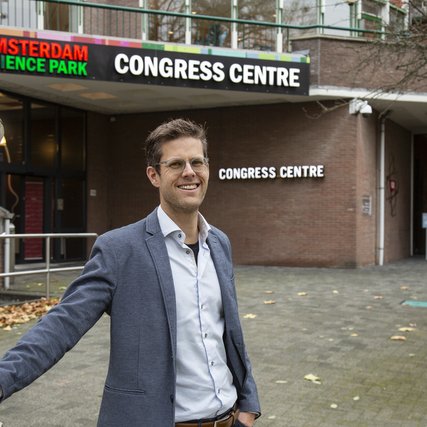


Events
All events-
StartEndFrom intrusive to non-intrusive model reduction: Structure preservation and exact operator inference
-
StartEndThis seminar brings together researchers working on recent advances in the variational multiscale (VMS) method. The event aims to foster interaction between experts in theoretical analysis, numerical methods, and applications of multiscale modeling.
-
StartEndModelling of CO2 Transport in Pipelines
Members

Associated members
Publications
All publicationsSoftware
Courses
All courses-
Uncertainty Quantification1 sep 2023 - 9 oct 2023
-
Uncertainty Quantification1 sep 2022 - 16 oct 2022
Current projects with external funding
- Discovering neural stochatsitc differential equations to simulate probabilistic tubulence (None)
- Learning small closure models for large multiscale problems. (None)
- Entropy-driven model reduction for fluid flows (SYMBIOSIS)
