News
Cryptology group news
CWI involved in two primary Post-Quantum Cryptography standards
The US National Institute of Standards and Technology (NIST) announced which cryptographic standards they selected to protect sensitive electronic data against the threat of quantum computers. Léo Ducas from CWI's Cryptology group …

Léo Ducas appointed professor of Mathematical Cryptology
Léo Ducas is appointed as a part-time professor Mathematical Cryptology at Leiden University. At CWI, he designed several cryptosystems, some of which might soon be adopted as new international standards.

The mathematics of privacy-friendly data sharing
For his work on the mathematics of privacy-friendly data sharing, Thomas Attema (TNO and CWI) won the TNO Young Excellent Researcher Award 2021. He was interviewed by TNO Insights.

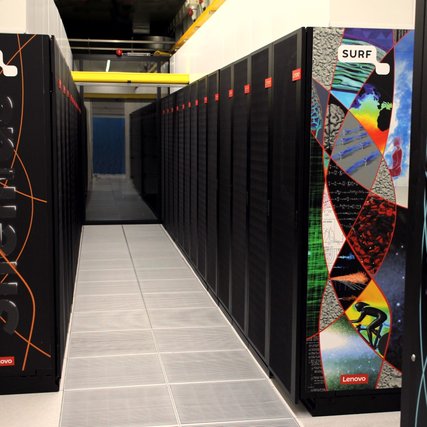
Hurray! A new national supercomputer: Snellius
On Thursday 16 September 2021, Queen Máxima performed the official opening of the new national supercomputer Snellius. CWI researchers have been computing on the national supercomputer since 1984: from testing security keys …
Secure multiparty computation starts to deliver applications
On Monday 13 September, the 23rd edition of CWI in Business took place, this year in cooperation with TNO. Subject this year: Secure Multiparty Computation.

Start of ACCSS - new association of cybersecurity academics
Last month, members of the ACCSS association celebrated that ACCSS (ACademic Cyber Security Society) is now a formal association. Marten van Dijk, head of CWI’s Computer Security research group, is one of …

TNO, CWI and TU Delft receive 1.8 million for research in quantum security of public key infrastructures
A consortium including TNO, CWI and TU Delft received a 1.8 million grant from NWO to conduct research in the quantum security of public key infrastructures (PKI), which form the basis for …

New code breaking record for quantum-safe cryptography
A team of CWI cryptanalysts has set a new code breaking record for the lattice shortest vector problem (SVP) - a foundation for the security of next generation public-key cryptography, designed to …

