Stories
In this section we publish more extensive stories about high-profile research or about CWI tackling social issues, or interviews with CWI researchers.
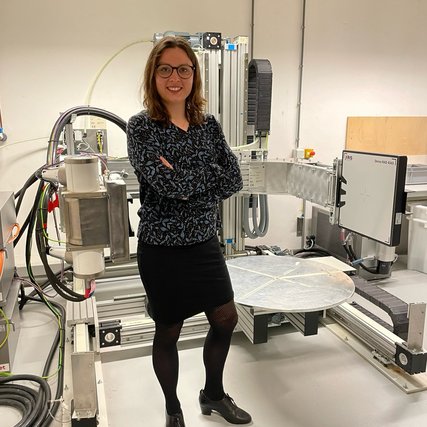
Francien Bossema: "In the museum world, I was the odd one out as a mathematician"
For her PhD research at CWI on heritage imaging research, Francien Bossema won the KHMW Thesis Award for Interdisciplinary Research 2025. On this occasion, the KHMW interviewed her.
Maximum quantum advantage in a sample-to-sample setting
In 2019, Google claimed to have achieved quantum advantage for the first time – through the results of an experiment that showed quantum computers are indeed faster than classical computers.
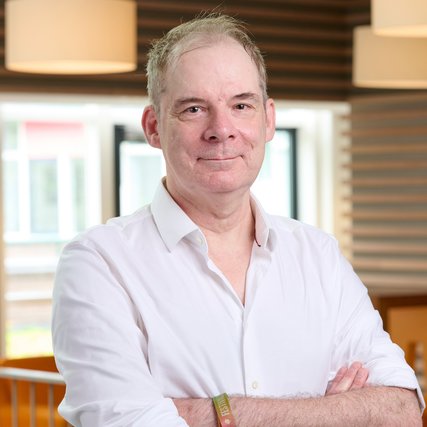
Han La Poutré: passionate about fundamentals with relevance
In his longstanding career, CWI-researcher and Professor of Intelligent Energy Systems at TU Delft Han La Poutré has continuously sunk his teeth into fundamental challenges with societal relevance. ‘Ever since I was …
How AI can improve 113 Suicide Prevention's counselling services
PhD student Salim Salmi studied how to use artificial intelligence (AI) to measure the quality of chat conversations with 113 Suicide Prevention. He then used the data to train an AI model …
Interview: Fascinated by random walks
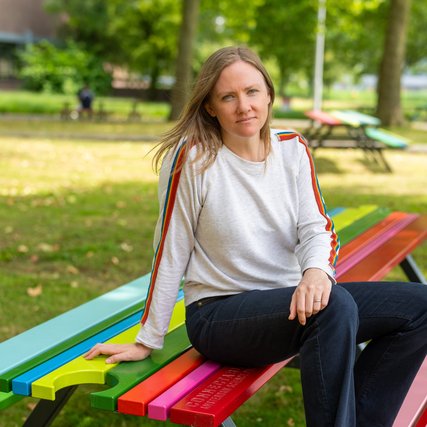
Quantum computing is an exciting field of research, according to researcher Stacey Jeffery (CWI, UvA and QuSoft). In May 2024 she also became professor by special appointment of quantum information at the …
Marten van Dijk: mathematician in computer security
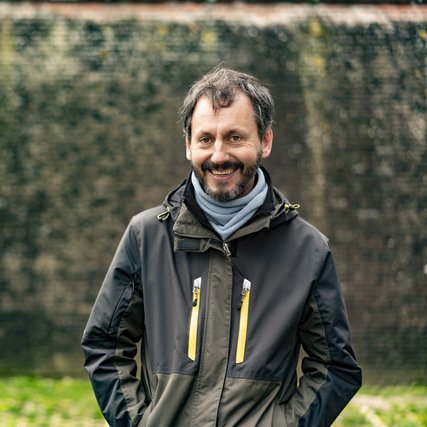
After having spent almost twenty years as a researcher in the United States, in 2020, Marten van Dijk returned to the Netherlands to found and lead the Computer Security group at CWI …
Data model predicts impact of healthcare supply chain transformations
In Zorgvisie magazine, professors Rob van der Mei (CWI & Free University Amsterdam) and Bianca Buurman (Amsterdam UMC) explain the five major areas of improvement they see for regional cooperation in acute …

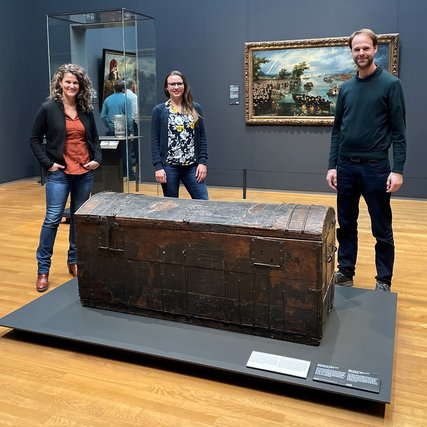
Looking back: the search for Hugo de Groot's book chest
In this series we look back on CWI events and accomplishments that were in the news fairly recently. This episode: the quest for the book chest in which Hugo de Groot escaped …