Description
SWAT studies software systems: their design, construction and evolution. Our mission is to learn to understand software systems and to improve their quality. In particular, we study the causes of software complexity – a major cause of technology failure in society – and investigate how complex systems can be made simpler and more reliable. We analyze and visualize software systems, transforming them into better versions of themselves. We also generate new software with the goal of simplifying it through automation and abstraction. We keep our feet on the ground by working with corporate IT departments on streamlining their software systems and making them more reliable. Putting our ideas into practice is the best way to ensure they work.
Vacancies
No vacancies currently.
News
CWI’s 25th spin-off develops software of the future
Swat.engineering generates new and transforms existing software based on domain knowledge.
Software engineering makes games more exciting
Creating good games with interesting game experiences is difficult. Software engineer Riemer van Rozen developed a domain-specific programming language (DSL) for games that allows game designers to design better games, in a faster way.
Software Engineering Symposium 2020 (SEN) at CWI
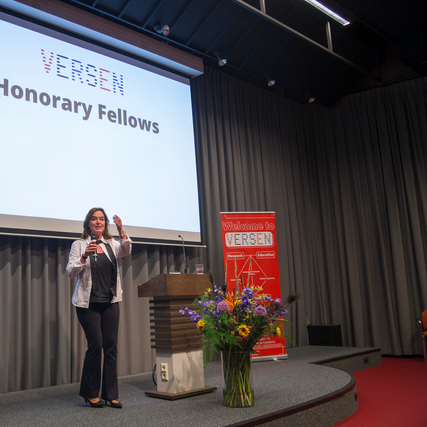
Coming Friday VERSEN organizes the sixth Dutch national software engineering symposium at CWI. It will feature six invited talks from academia and industry.
Most Influential Paper award for SWAT researchers at SCAM ‘19
CWI’s SWAT group has been awarded the prize for most influential paper for the article that introduced programming language Rascal ten years ago at the SCAM conference.
Members
Associated Members
Publications
-
van Binsbergen, L.T, Liu, L.-C, van Doesburg, R., & van Engers, T. (2020). eFLINT: a domain-specific language for executable norm specifications. In Proceedings of the ACM SIGPLAN International Conference on Generative Programming: Concepts and Experiences. doi:10.1145/3425898.3426958
-
van Binsbergen, L.T, Scott, E, & Johnstone, A. (2020). Purely functional GLL parsing. Journal of Computer Languages, 58. doi:10.1016/j.cola.2020.100945
-
Leduc, M, Degueule, T.F, van Wyk, E, & Combemale, B. (2019). The software Language Extension Problem. Software and Systems Modeling. doi:10.1007/s10270-019-00772-7
-
Stoel, J, van der Storm, T, & Vinju, J.J. (2019). AlleAlle: Bounded relational model finding with unbounded data. In Onward! 2019 - Proceedings of the 2019 ACM SIGPLAN International Symposium on New Ideas, New Paradigms, and Reflections on Programming and Software, co-located with SPLASH 2019 (pp. 46–61). doi:10.1145/3359591.3359726
-
Klint, P, van der Storm, T, & Vinju, J.J. (2019). Rascal, 10 years later. In Proceedings of the International Working Conference on Source Code Analysis and Manipulation (pp. 139–139). doi:10.1109/SCAM.2019.00023
-
van Rozen, R.A, & van der Storm, T. (2019). Toward Live Domain-Specific Languages: From Text Differencing to Adapting Models at Run Time. Software and Systems Modeling. doi:10.1007/s10270-017-0608-7
-
Bezirgiannis, N, de Boer, F.S, Johnsen, E.B, Pun, K.I, & Tapia Tarifa, S.L. (2019). Implementing SOS with active objects: A case study of a multicore memory system. In FASE 2019: Fundamental Approaches to Software Engineering (pp. 332–350). doi:10.1007/978-3-030-16722-6_20
-
van Binsbergen, L.T. (2019, April). Executable Formal Specification of Programming Languages with Reusable Components.
-
Ochoa, L.M, González-Rojas, O, Cardozo, N, González, A, Chavarriaga, J, Casallas, R, & Díaz, J.F. (2019). Constraint programming heuristics for configuring optimal products in multi product lines. Information Sciences, 474, 33–47. doi:10.1016/j.ins.2018.09.042
-
Aarssen, R.T.A, Vinju, J.J, & van der Storm, T. (2019). Concrete syntax with black box parsers. The Art, Science, and Engineering of Programming, 3(3). doi:10.22152/programming-journal.org/2019/3/15
Software
Rascal: one-stop shop for metaprogramming
Rascal is a general metaprogramming language, facilitating programmers in analyzing, transforming and generating source code.
Rebel: A domain-specific language for product development in finance
Rebel is a domain-specific language (DSL) targeted at the financial sector.
SAGA: A run-time verifier for Java programs
SAGA is a run-time verifier for single-threaded as well as multi-threaded Java programs.
Current projects with external funding
-
Enterprise software engineering ()
-
Polyglot and Hybrid Persistence Architectures for Big Data Analytics (TYPHON)
Related partners
-
ING Bank
-
Universita Degli Studi Dell'Qquila
-
University of York
-
Alpha Bank Anonymos Etairia
-
Institut für Angewandte Systemtechnik Bremen
-
Zorgios Ioannis
-
Edge Hill University
-
GMV Aerospace and Defence SA
-
Universite de Namur ASBL
-
Nea Odos Anonymi Eteria Parahorisis
-
SWAT.Engineering
-
X/Open Company Limited
-
Volkswagen AG