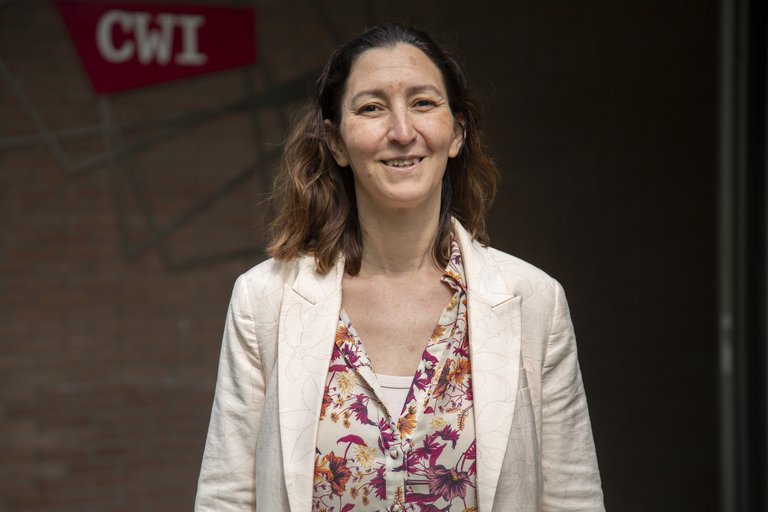
Nava Tintarev is Professor at Maastricht University, the Chair of the informatics roundtable (Informaticatafel), and a Board member of IPN (ICT Research Platform Nederland). Before settling in the Netherlands, she studied and worked in several countries, including Sweden, Australia, England, Scotland, and Spain. She holds a bachelor’s degree in computer science and also studied psychology as a minor.
In her professorship, these two sides of her expertise come together. Her work combines computer science with research into how people experience and use technology. “I study, among other things, how AI systems can better explain their recommendations,” Tintarev says. “Think of Spotify or Netflix, where users receive recommendations for music, films or series. Often, you see what the system recommends, but not why.”
Tintarev develops interactive explanations for such systems, helping users understand how a recommendation was made and allowing them to adjust or challenge it. The aim is to develop AI that is not only technically capable but also gives people more insight and control.
During your stay at CWI, you organized a symposium on bias in AI together with Professor Laura Hollink from the Human-Centered Data Analytics group. You gave a keynote titled “Whom are you explaining to, and why?” Why is that question so important?
“Explanations can be useful, but people do not always agree on why they are useful. If people want explanations for different reasons, the explanations themselves may also need to be different. People also understand explanations better when they are tailored to them.”
How big is the issue of bias in AI?
“It is huge. And it is systematic. We already live in a world that is not balanced. For instance, some people are more likely than others to receive a bank loan.
When you develop a large language model, you make decisions about what to include and exclude in the design. The model may then amplify some patterns and suppress others. And of course, humans are biased too. A bank manager who estimates who should receive a loan may be biased, but an AI system can be biased as well.
As a scientist, I see bias in data. For example, we know that for a long time, heart attacks were often not recognized in women. That was not necessarily due to deliberate discrimination, but because of the data on which healthcare knowledge and decision-making were based. If bias is made visible, it can be addressed.
Through my visit to CWI, I hope to bring together people who study different stages of the AI process: from the data used to train systems, how models are built and evaluated, all the way to the way their outcomes are explained and used in practice.
The symposium on bias in AI was fully booked, with participants from almost every Dutch university, from various disciplines, and from organizations such as banks, the Dutch Data Protection Authority and TNO. We want to help build a Dutch community around responsible AI.”
What do you hope to gain from your visit to CWI?
“With Laura, I am exploring opportunities to continue this line of research. That also means looking at possibilities to apply for funding together. But more importantly, this is a time to think about questions like: are we doing the right research, what are the questions we should be asking?
Secondly, you really need space in your agenda to think freely. In my day-to-day job, my time is filled with administration, teaching, supervision, and the other responsibilities that come with being a professor. I am also involved in various committees. Due to all those meetings, my days are often chopped up, which makes it hard to find long stretches of time to focus on one thing. Here, I have fewer obligations. I have time to read, write, and talk to people I would not normally meet.”
What stayed with you most from your time at CWI?
“CWI is really designed for science. People here are given a lot of freedom to read, think and develop new ideas. There is also a great deal of expertise here.”
What becomes possible during a research visit that is difficult to achieve through regular meetings or conferences?
“You can exchange expertise in a much deeper way. It is so much easier to apply for a research grant together, or to work on something together, if you know and trust each other, know each other’s work and have a deeper understanding of it.
There is a lot you can do online, but you can only really plant the seeds when you are in the same place.”