In Dutch, L.INT stands for “lectureships and institutes”. It enables a lecturer, who is a PhD researcher at a university of applied sciences and often has their own research group, to collaborate with a research institution for a period of four years. The sustainable collaboration between universities of applied sciences and research organisations that this creates strengthens research throughout the entire innovation chain.
Industrial Digital Twins
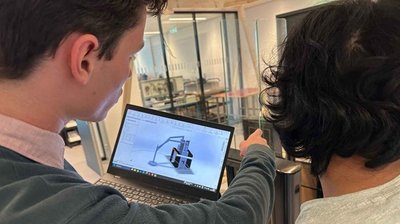
Computer scientist Jurjen Helmus has been a lecturer in Industrial Digital Twins at Amsterdam University of Applied Sciences (HvA) since September 2024. Together with CWI and a diverse group of students, he creates digital versions of physical objects. ‘I digitise the physical world and bring the results to life with scale models in my lab. I take that physical aspect with me to CWI: this is unique in an institute that is best known for its many computers and bright minds. I really try to be a link between practice-oriented research at our university and the theoretical knowledge of CWI. That is my L.INT lectureship.’
His HvA colleague Nanda Piersma (now scientific director at the Centre of Expertise Applied AI) was an L.INT lecturer herself and advised Jurjen to submit the L.INT application. "She believed I should get support for this. CWI has solutions for hypothetical problems. I have practical problems for those solutions and connect industrial parties from the region to CWI." The collaboration between the institute and the university of applied sciences is going well. Jurjen: "I work with Tim Baarslag's Intelligent and Autonomous Systems team for one to one and a half days a week. They are exceptionally well-versed in theory, and I use their knowledge to solve industrial problems on a project basis. CWI colleagues also come to my lab at the university of applied sciences. That connection has great added value for all of us."