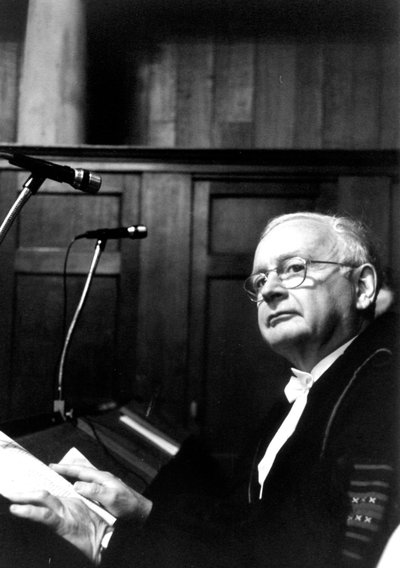
Search of new purpose was what brought Adriaan van Wijngaarden to that doorstep.
The invitation to address the International Congress of Mathematicians in Edinburgh, August 1958, had certainly been a jewel in his crown. On August 18 he gave his talk on ‘Summation of series,’ contributing to the very core of numerical analysis, then moved on to spend holidays in Scotland with his wife. Aad van Wijngaarden and his wife Babs were involved in a car crash. His wife died and he was seriously injured, hospitalized for three full months. He was devastated.
Seeking a road to recovery, he made a deliberate new start. Some of his closest friends shared the sad experience of being put at a distance; seeing their friendship frozen. Now specializing in programming languages, Aad sought a new subject and new company.
Van Wijngaarden had always kept a fascination for language, but up to this point had left the reflection on programming largely to Edsger Dijkstra. Specializing in programming languages, he joined the very next meeting in February 1959 in Copenhagen. At the following meeting in Mainz in July, Friedrich Bauer expressed his delight with the new participation. Aad van Wijngaarden returned the compliment and added that now that they were working so closely together, they might be less formal: “My name is Aad.” Clearly, this was his new company.
The ACM-GaMM committee was proceeding towards an agreement on ALGOL at a high pace. The increased informality was perhaps helpful; the main factor was certainly the manner in which Peter Naur in Copenhagen took minutes and circulated the ALGOL Bulletin. Commissoned to take minutes he was the de facto editor.
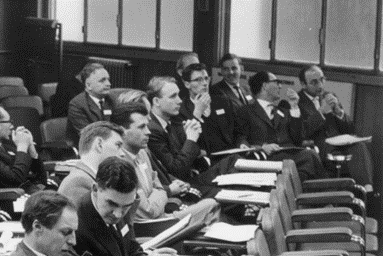
ALGOL in Parijs, late1959
Far right Friedrich Bauer
Second right Klaus Samelson
Fourth right Edsger Dijkstra;
achter hem op de derde rij Aad van Wijngaarden.
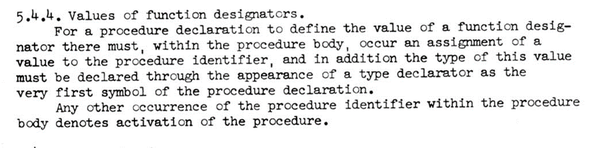
Further meetings in Paris in November and in Mainz in December prepared for the ALGOL 60 meeting in Paris in January 1960. Amidst all of this, Van Wijngaarden and Dijkstra had their own agenda. For them it was a matter of beauty and a matter of decency that ALGOL, allow the most general of constructions to define procedures; it should allow recursive procedures. As a general principle this had been voted down in Paris. They did not give up. In the next month Van Wijngaarden, seconded by Dijkstra, called Peter Naur on the telephone. They proposed a text that spelled out the acceptance of recursive procedures --without mentioning the notion of recursion. Naur, in turn, consulted Friedrich Bauer. Bauer clearly understood the phrase and understood that he had lost the play on words. He agreed, and that was the acceptance of the recursion in ALGOL 60:
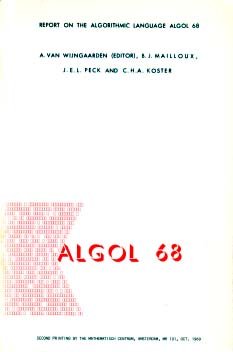
ALGOL 60 was published and met with enthusiasm. It was accepted in the broader community of working with programming languages. By itself it became the standard of what was since called a higher-level programming language.
From that point on three simultaneous developments took place: the implementation of ALGOL 60; the founding of IFIP; the adoption of ALGOL by IFIP.
One may replace programming systems with programming languages, but that does by itself yield a working system, an operating system. Creating such a system would be called “implementation”, sometimes also a “translation”. In other words, creating a programming system based on ALGOL 60 was the implementation of ALGOL 60. On their next visit to Copenhagen in March 1960, Edsger Dijkstra, Jaap Zonneveld, Freek Barning, and Aad van Wijngaarden discussed the task of making an implementation of ALGOL 60. They self-imposed a challenge that they would do so in 6 months and challenged the team in Copenhagen to come and see them in August and observe the implementation of ALGOL in operation. Dijkstra and Zonneveld did the work. They were well on time, but Naur had not taken their challenge seriously and did not show up in Amsterdam. The international ALGOL community was baffled. They delivered a transparent and beautiful product. Their British colleague Brian Randell noted that a new standard had been set for the writing of implementations.
In parallel to the growth of an informal ALGOL community, a more formal grouping originated in the same year, in the same city, and with many of the same participants. Isaac Auerbach had been chairing a committee of the professional societies in the U.S. aiming to spread their wings internationally. Their aspiration was organize an international conference on information processing. Once appointed U.S. delegate to UNESCO, Auerbach carried with him to Paris the initiative to organize. The International Conference on Information Processing was held in June, 1959. Aiken, Householder, Wilkes, Walther, they all participated. Van Wijngaarden came on special invitation and was awarded the silver medal of the city of Paris. The overt initiative concealed another, namely, to set up an international organization for information processing. That secondary agenda required more diplomacy than expected. Eastern European delegations were willing to join only if participation was restricted to one society per country; no individual members. The result was a federation, the International Federation of Information Processing Societies, IFIPS. Later, in 1961, the S was dropped from the name, IFIP. The federation was founded with 13 members on January 1, 1960. Thanks to Van Wijngaarden, the Netherlands were in.
In June 1958, while preparing the conference, he had realized that the Netherlands didn't even have a society that could participate in a federation. Just in time for IFIP the Nederlands Rekenmachinegenootschap was founded, NRMG holding its 0th meeting on April 25, 1959.
The Federation existed, but only barely. Two years on, a further congress was convened in Munich, by the success of which IFIP proved its viability. It got itself organized into TC’s, technical committees and these TC’s each had several working groups, the most important of which was WG 2.1 on Algorithmic Languages. At this point the two streams of events merged. ALGOL was now a matter for IFIP and the ALGOL committee was now an IFIP working group.