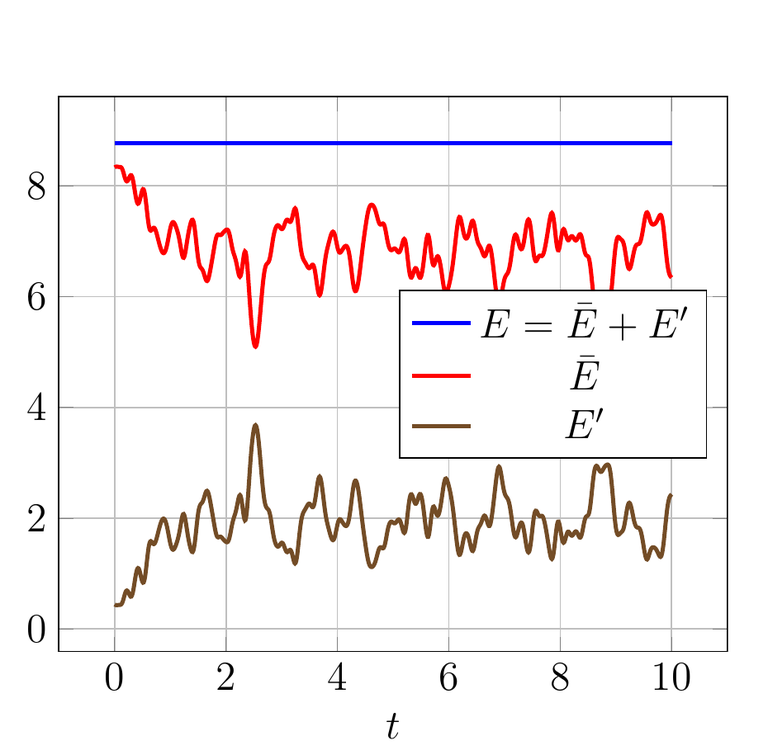
Both ū and s are evolved in time using our newly developed skew-symmetric neural network architecture that ensures that this condition is satisfied, yielding stability. Currently, these SGS variables are constructed by applying a linear filter, learned from highresolution simulations, to u′ which compresses the SGS content onto the coarse grid reducing the degrees of freedom of the system from N to 2I.
3. Objectives & project outline
For this project we are mainly interested in gaining more understanding of both the theoretical and practical aspects of the SGS variables. We therefore propose the following outline of the project:
- Literature study on: partial differential equations, computational fluid mechanics, closure modelling, machine learning [2–5, 8, 9].
- Theoretical study on the SGS variables: What do they represent?
- Suggest new forms for the SGS variables, e.g. neural networks.
- Possibly suggest new neural network architectures (or non-data-driven approaches, linear models etc.) for the closure model, derived from energy arguments.
- Implement SGS variables and compare performance for the convection-diffusion equation.
- If everything goes well: Burgers equation, Korteweg-de Vries equation, possibly Navier-Stokes.
References
[1] P. Sagaut and C. Meneveau. Large Eddy Simulation for Incompressible Flows: An Introduction. Scientific Computation. Springer, 2006. ISBN 9783540263449. URL https://books.google.nl/ books?id=ODYiH6RNyoQC.
[2] Syver Døving Agdestein and Benjamin Sanderse. Learning filtered discretization operators: non- intrusive versus intrusive approaches, 2022. URL https://arxiv.org/abs/2208.09363.
[3] Hugo Melchers. Machine learning for closure models. Master’s thesis, June 2022.
[4] Yohai Bar-Sinai, Stephan Hoyer, Jason Hickey, and Michael P. Brenner. Learning data-driven discretizations for partial differential equations. Proceedings of the National Academy of Sciences, 116(31):15344–15349, 2019. doi: 10.1073/pnas.1814058116. URL https://www.pnas.org/doi/ abs/10.1073/pnas.1814058116.
[5] Andrea Beck, David Flad, and Claus-Dieter Munz. Deep neural networks for data-driven les closure models. Journal of Computational Physics, 398:108910, 2019. ISSN 0021-9991. doi: https: //doi.org/10.1016/j.jcp.2019.108910. URL https://www.sciencedirect.com/science/article/ pii/S0021999119306151.
[6] Jonghwan Park and Haecheon Choi. Toward neural-network-based large eddy simulation: applica- tion to turbulent channel flow. Journal of Fluid Mechanics, 914:A16, 2021. doi: 10.1017/jfm.2020. 931.
[7] Jin-Liang Yan and Liang-Hong Zheng. A class of momentum-preserving finite difference schemes for the korteweg-de vries equation. Computational Mathematics and Mathematical Physics, 59(10): 1582–1596, Oct 2019. ISSN 1555-6662. doi: 10.1134/S0965542519100154. URL https://doi.org/ 10.1134/S0965542519100154. 3
[8] Antony Jameson. The construction of discretely conservative finite volume schemes that also globally conserve energy or entropy. J. Sci. Comput., 34:152–187, 02 2008. doi: 10.1007/ s10915-007-9171-7.
[9] Marius Kurz and Andrea Beck. Investigating model-data inconsistency in data-informed turbulence closure terms. 02 2021. doi: 10.23967/wccm-eccomas.2020.115.