In the Netherlands, most residual household waste is transported by truck to incineration plants. That system is vulnerable. Many bridges and viaducts were built in the 1950s and 1960s and are due for renovation. As a result, they can carry fewer and fewer heavy vehicles. The closure of the A7 was not an isolated incident, but a sign of what is likely to happen more often.
Electric vessels
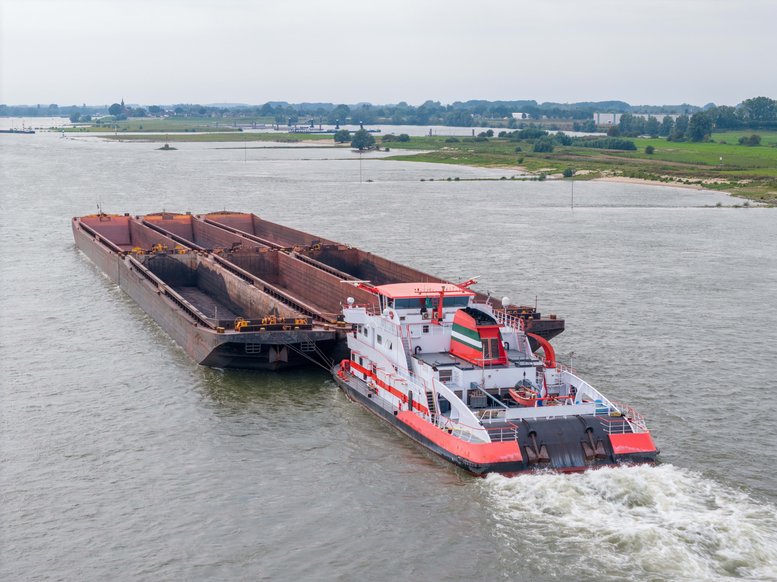
Researchers from the Stochastics group at Centrum Wiskunde & Informatica, together with Business Analytics students from VU Amsterdam, analyzed household waste transport from 55 municipalities in North and South Holland and Flevoland. Using mathematical optimization models, they evaluated several scenarios for waste transport: trucks only; a combination of trucks and diesel-powered vessels; and a combination of trucks and electric push boats. In these scenarios, waste is first transported by truck to transfer points on the water and then shipped to the incineration plants.
The results are striking. In the most sustainable scenario, with electric vessels, total costs fall by almost 20% compared with road-only transport. At the same time, CO₂ emissions decrease by more than 40%. The number of truck kilometres also almost halves. Even with diesel-powered vessels there are clear advantages, although electric vessels remain the cleanest option.
Municipalities need to collaborate
According to the researchers, the gain is not only in technology, but especially in system design. Compared with food, waste is not very perishable, does not need to arrive extremely quickly, and is well suited to bundling. This makes household residual waste suitable for transport by water. Moreover, the Netherlands’ many waterways form an infrastructure that can relieve pressure on the road network. A key condition is collaboration: municipalities need to combine waste flows and share transfer points.
This also leads to the main recommendation of the researchers: build waste-processing facilities and transfer locations along waterways, and organize logistics around them. Those who keep planning from the motorway will get stuck - literally and figuratively.
Major opportunities
The research was published in the scientific journal Waste Management. The authors’ message is primarily relevant for policymakers. The Netherlands is facing large-scale maintenance of roads and bridges, while climate targets are becoming more stringent. Transporting waste by water appears to be a rare combination of lower costs and lower emissions.
“This research shows there is often capacity on waterways to relieve pressure on the road network,” say CWI researchers Jesse Nagel and Rob van der Mei. “And not only for household waste, but also for other sectors - think construction logistics, or supplying retail. There are major opportunities here!”