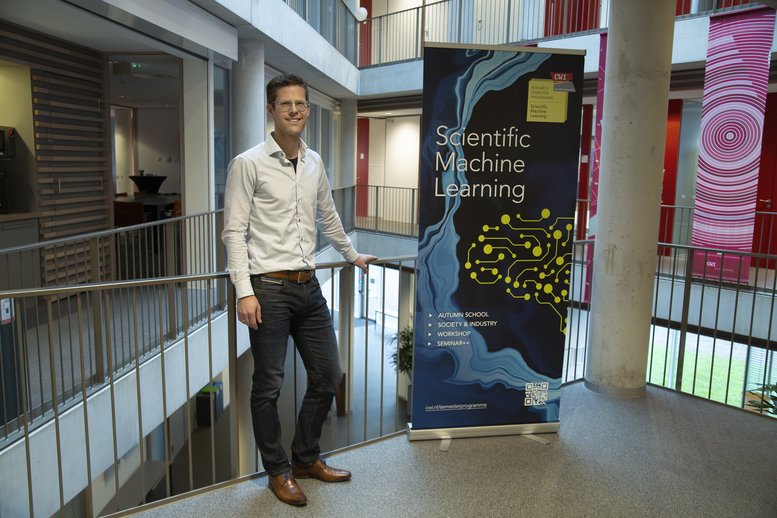
The ERC Consolidator Grant is a personal award intended for academics who wish to establish or strengthen their independence, by setting up or consolidating a research team. Sanderse, group leader of Scientific Computing at CWI and part-time associate professor at Eindhoven University of Technology, will use the two million euro grant to address a problem that arises when attempting to predict flows of air, water or gases.
The problem begins with the way in which flows are currently computed. In so-called Computational Fluid Dynamics models, space is divided into a fine grid of points, and at each point the velocity, pressure and temperature of the fluid are calculated. For simple (laminar) flows this works well, but in practice flows are usually turbulent: full of eddies and vortices of many different sizes. To resolve all of these eddies, the computations become so demanding that they are intractable even for supercomputers.
Engineers therefore use a workaround: they compute only the large-scale motions of the flow and capture the effect of the smallest eddies with a so-called “closure model”. That model effectively “fills in” the missing physics. However, it is precisely these closure models that are the weak link. They often turn out to be unstable, do not always respect the laws of nature, and in complex situations – such as large wind farms – lack sufficient accuracy.
Entropy as a solution
Over the past years, two main approaches have been pursued worldwide. On the one hand are models derived purely from physics, based on simple assumptions about how small eddies behave on average. On the other hand, data-driven models have emerged that use machine learning to extract patterns from highly detailed simulations or measurements. These latter models are promising, but require vast amounts of data, are difficult to interpret, and offer no firm guarantees of stability or physical correctness. Sanderse notes: ‘Physics alone is not enough, but data alone is not enough either.’
In his new project – named SYMBIOSIS – he proposes a radical middle way centred around the key concept of entropy for learning closure models. In physics and mathematics, entropy is a measure of the direction of processes and indicates what is physically admissible. In information theory, entropy can quantify how much uncertainty there is in a prediction and enables a probabilistic view on closure models. Sanderse aims to combine these two roles in a symbiotic way. The mathematical-physical entropy ensures that the new closure models remain stable and obey fundamental physical laws. The information-theoretic entropy will be used to assess whether the statistics of turbulence are correct: not whether every number is exactly right, but whether the distribution of velocities and pressures matches the real flow.
Energy applications and beyond
Once this approach succeeds, it can have direct consequences for the way in which we shape the energy transition. For example, probabilistic models (which explicitly take uncertainty into account) of turbulent airflows behind wind turbines would make it possible to design wind farms more efficiently and operate them more intelligently, thereby extracting more power from the same amount of wind. Another example handled in SYMBIOSIS is the simulation of turbulent flow of compressible CO2, which is crucial in the design of heat exchangers and transportation systems.
Since the computational tools Sanderse intends to develop consist, at their core, of generic mathematical methods to deal with complex multi-scale systems, they can potentially also be applied in many other domains beyond the energy sector. These include, for example, weather and climate models and life sciences applications.
The European grant gives Sanderse five years to build a team and execute his ideas. ‘The ultimate goal is not to “tame” turbulence in the sense of creating predictable calm, but to model the chaos in such a way that we can make reliable statistical statements about it,’ Sanderse explains.