Beertema came up with an alternative that now sounds entirely logical, but at the time still had to be devised and put into practice: using national domain names. He applied for .nl for the Netherlands. In retrospect, that may seem like a small technical step, but it had major consequences. Not only did it give the Netherlands its own country-code domain, it also created a structure that could scale as the network expanded rapidly.
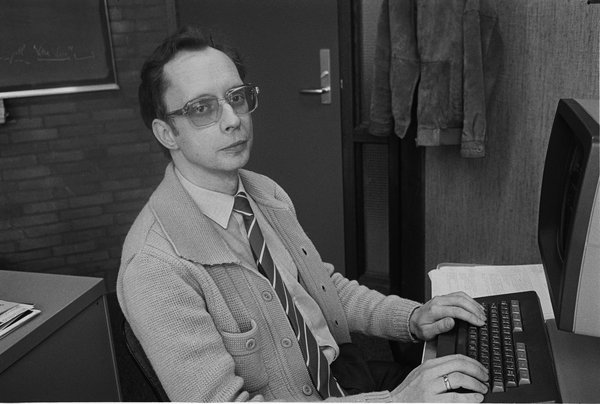 Piet Beertema at CWI in 1985. Photo: Pieter Boersma
Beertema himself describes how unceremonious that moment really was. “I got a reply much faster than I had expected. Not after several months, but after just a few days. So I started with an extremely modern technology: by hand and in plain text.”
A do-it-yourself package
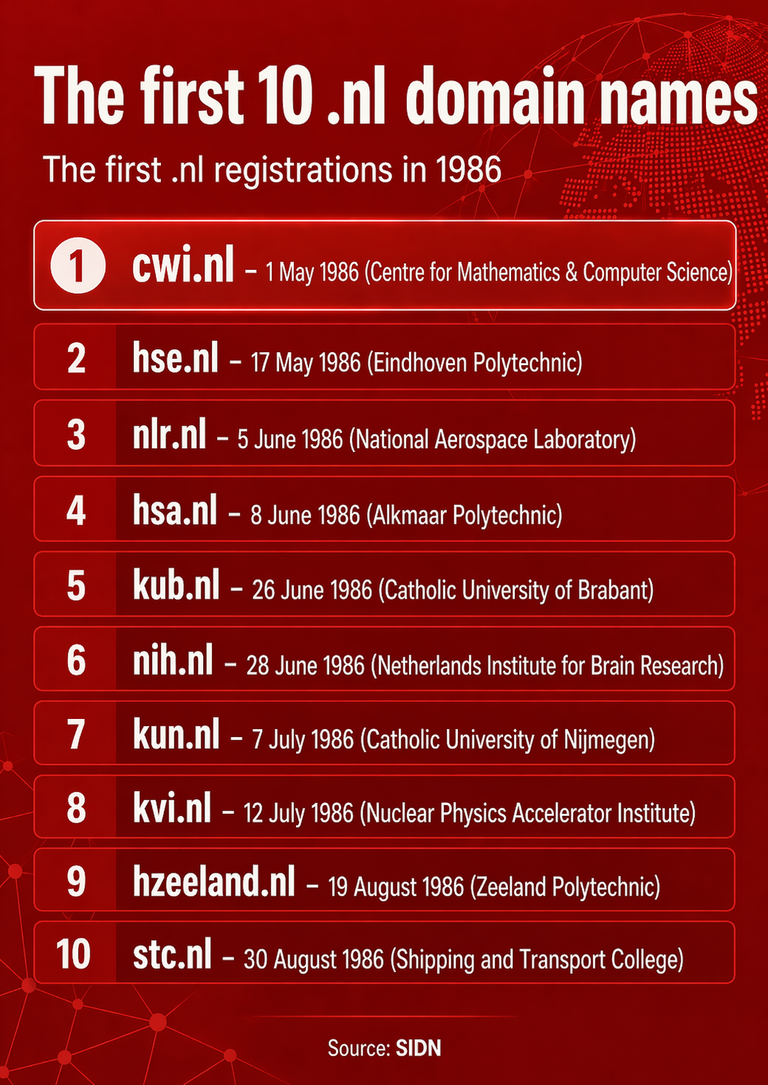
CWI’s close connection to the origins of .nl is also reflected in that very first registration. On 1 May 1986, cwi.nl was recorded as the first .nl domain name. Other names from knowledge institutes and organisations soon followed, from hse.nl to nlr.nl and kub.nl. The top ten of the earliest registrations offers a glimpse of an early internet world in which public and academic institutions featured prominently — unsurprising in a period when the internet was still far from a mass medium.
Beertema did not stop at applying for .nl. After the domain had been granted, he put together a do-it-yourself package for his European colleagues, enabling other countries to register their own internet domains as well. As a result, many European countries quickly acquired domains of their own. “It was pioneering work. We really started with nothing.”
That early phase lasted longer than you might think. For the first ten years, from 1986 to 1996, Beertema was responsible for assigning and registering .nl domain names. This was still done manually, at a time when the scale remained manageable enough for that to work. But the success of .nl soon made it clear that a more professional organization was needed. That is why SIDN was founded in 1996 by three parties involved with .nl in its early years: CWI, SURFnet and NLnet.
From 1 name to 6 million names
Since then, .nl has grown from a technical registration system into a national digital utility. SIDN handles applications for new and existing .nl domain names and ensures that users are directed to the right website or email address. This so-called resolving now takes place more than 4 billion times a day. In the meantime, .nl has grown to more than 6 million registered domain names and, according to SIDN, ranks fourth among the world’s largest country-code domains.
That growth did not happen in a straight line. For a long time, .nl domain names were available only to companies and organisations with a Chamber of Commerce registration. It was not until 2003 that private individuals could also apply for a .nl domain name. After that, growth accelerated: from just over 1 million domain names in 2003 to 4 million in 2010, 5 million in 2012 and more than 6 million in 2020. What began as a solution to a technical naming problem became a familiar part of everyday digital life in the Netherlands.
A huge boost for the internet
Beertema looks back on it with characteristic understatement. “It has all got a little out of hand, I might say. The development of the World Wide Web was the big breakthrough for the internet.” Behind that two-letter suffix now lies an entire world of companies, schools, government bodies, webshops, email traffic and digital services.
Forty years of .nl is therefore not just the anniversary of a technical standard. It is also a reminder of a time when fundamental decisions about the structure of the internet were still being made in a relatively small circle.
This article is based on a press release of SIDN.