An older person is medically ready to leave hospital, but cannot yet return home and no suitable nursing-home bed is available. The patient therefore remains in hospital, occupying a bed intended for acute care. Meanwhile, other patients may have to wait or be turned away. This is one example of the bottlenecks studied by Tim de Boer, who will defend his PhD thesis at Vrije Universiteit Amsterdam on 17 June. His research examines how mathematics and data can help healthcare providers use limited capacity more effectively and prevent older people from becoming trapped between different forms of care.
System under pressure
Care for older adults operates as a closely connected network. A hospital may only be able to discharge a patient when home care, rehabilitation or a nursing-home place is available. A shortage in one part of the system can therefore cause queues elsewhere. With an ageing population, rising costs and staff shortages, these dependencies are placing increasing pressure on the system.

De Boer studied the problem from two sides: how older people move through the care system, and how limited capacity affects those movements. He used methods including data analysis, queueing theory, optimization and computer simulations.
Home care as an early warning signal
Analysis of Dutch healthcare data showed that it matters which type of home care a person receives. Older adults receiving personal care, such as nursing support at home, were more likely to experience an emergency-department visit, hospital admission or nursing-home admission than people receiving no formal home care.
This does not mean that home care causes these problems. Rather, the type of support someone needs can provide an accessible indication of their vulnerability. According to De Boer’s research, healthcare providers could use this information to identify high-risk groups and offer preventive support before a crisis occurs.
His models also explore when admission to a nursing home may be appropriate. They illustrate the trade-off between admitting someone too early, when they might still live at home, and waiting until declining health results in an emergency. Regularly assessing a person’s condition could support more individualized decisions.
Tackling blockages through coordination
De Boer also modelled situations in which patients cannot move to the next form of care because it is full. Such blockages can spread through the system and, in extreme cases, create a standstill in which different services are effectively waiting for one another.
In a simulation based on care for older adults in the Amsterdam region, a coordination mechanism that regularly resolved these blockages reduced rejected patients by up to about 10 per cent and days spent in the wrong type of bed by up to about 20 per cent over a ten-year period. These improvements were achieved without increasing the total capacity in the model.
The results indicate that capacity should not be managed by each hospital or care provider in isolation. Sharing information and coordinating available places across organizations can allow a surplus in one location to compensate for a shortage elsewhere.
About the research
Tim de Boer conducted his research within the NWO-funded DOLCE VITA project, a collaboration between CWI, Amsterdam UMC, Vrije Universiteit Amsterdam and regional healthcare network Sigra. He carried out his PhD research in CWI’s Stochastics research group.
About the thesis
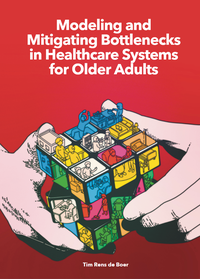
Title: Modeling and mitigating bottlenecks in healthcare systems for older adults
Supervisors: Rob van der Mei (CWI) and Sandjai Bhulai (VU)
Co-supervisors: Bianca Buurman (Amsterdam UMC) and René Bekker (VU)
