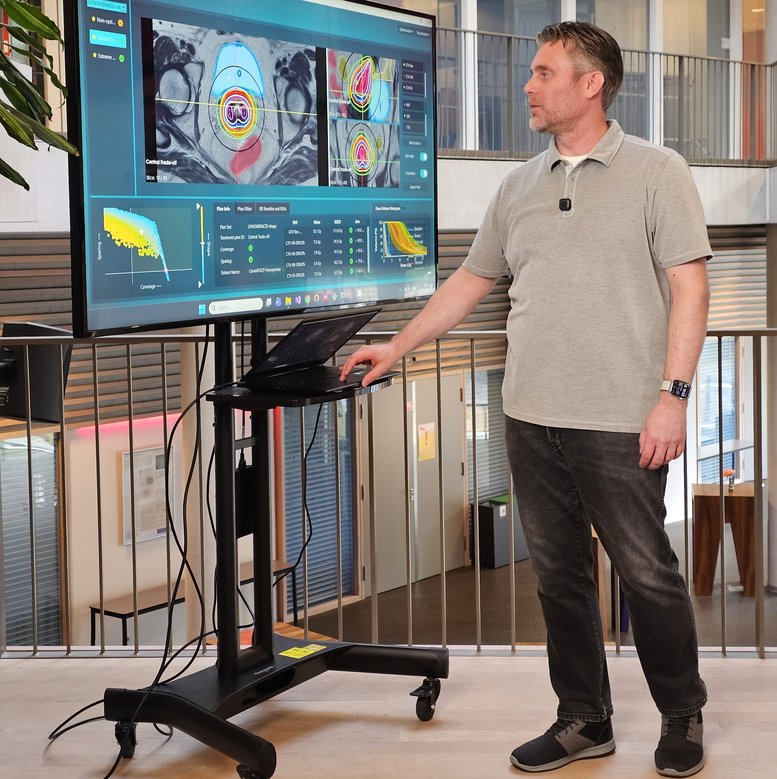
Six projects were selected from a total of 33 submissions. In its report (in Dutch), the jury describes Bosman’s body of work as ‘impressive’, citing, among other things, its broad applicability. ‘His research […] offers a compelling insight into the power of AI in healthcare. More importantly, despite its complexity, its essence is accessible to a wide audience. In doing so, Bosman also demonstrates how science can connect with society. We will undoubtedly hear much more in the coming years about Peter Bosman’s pioneering work and its applications.’
Peter Bosman leads CWI’s Evolutionary Intelligence research group and is a part-time professor at Delft University of Technology. He developed the algorithm that underpins BRIGHT, an AI system that helps doctors create treatment plans for patients receiving brachytherapy, a form of internal radiotherapy.
From an hour to a matter of seconds
Brachytherapy is used primarily to treat prostate, cervical and breast cancer. At the start of treatment, a temporary implant is inserted near the tumour. A machine then guides a radioactive source through the implant, pausing briefly at different positions. The longer the source remains at a particular position, the more radiation it delivers there. The aim is to irradiate as much of the tumour as possible while exposing healthy tissue to as little radiation as possible.
Where the source should stop and for how long is generally determined manually by a team comprising a doctor, a medical physicist and a radiotherapy technologist. For prostate cancer, this can take up to an hour, while the patient waits on the treatment table with the implant already in place.
BRIGHT generates a range of treatment plans in a matter of seconds: from plans that irradiate as much of the tumour as possible to plans that spare healthy tissue as much as possible. The system identifies balanced trade-offs between these two objectives, giving doctors a clear overview of the most relevant treatment options. Finding such trade-offs is technically challenging.
User interface
BRIGHT is now much more than an optimization algorithm. The current version has a broader range of applications and can create treatment plans for any form of cancer treated with brachytherapy. A unique user interface allows doctors to inspect the optimized plans directly. At a glance, they can see whether a treatment can meet all the predefined requirements and which options are most suitable for the patient.
Within minutes, several suitable treatment plans can be selected and compared, allowing the treatment team to choose the best balance and begin treatment. As a result, the patient spends considerably less time waiting on the treatment table.
Teamwork
The scope of BRIGHT continues to expand. Partnerships now include clinics in the Netherlands, Denmark, Austria, the United States and New Zealand. The feedback from these collaborations has been consistent: BRIGHT provides greater insight and makes it possible to arrive at better treatment plans faster than before.
‘I could never have developed BRIGHT on my own,’ Bosman says of his nomination. ‘We made this happen as a team of doctors, medical physicists, radiotherapy technologists and researchers.’
CWI works closely in this field with Amsterdam UMC and Leiden University Medical Center (LUMC). BRIGHT is already used at Amsterdam UMC to treat patients with prostate cancer. Both medical centres are preparing to begin using BRIGHT for cervical cancer later this year.
The Swedish technology company Elekta is also involved. It develops radiotherapy equipment and software for cancer treatment and is the market leader in brachytherapy. Bosman: ‘My hope is that hospitals around the world will be able to use BRIGHT in the future.’
About the Huibregtsen Prize
The Huibregtsen Prize was established in 2005 by Stichting De Avond van Wetenschap & Maatschappij. It is named after Mickey Huibregtsen, who founded the event. The prize recognises a recent research project that combines scientific quality and innovation with exceptional societal value or outreach.
Read the press release (in Dutch) from Stichting De Avond van Wetenschap & Maatschappij
Headerphoto: Frank Schoevaart