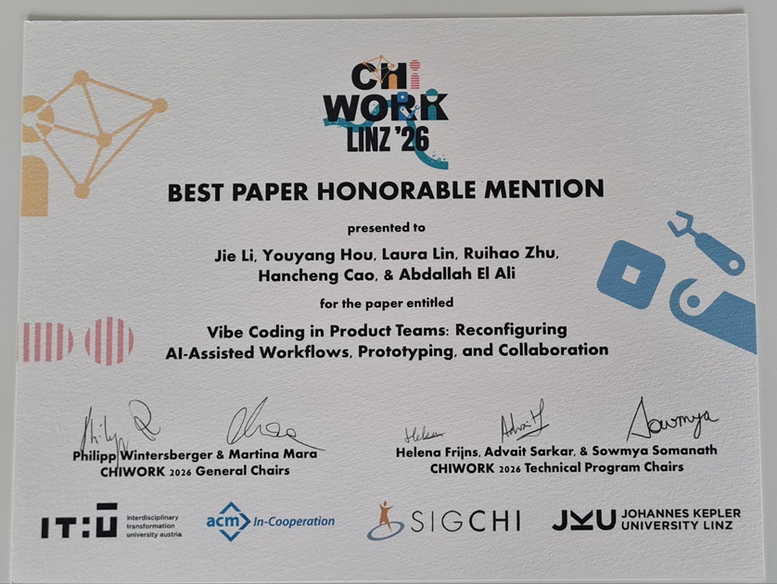
The research dives deep into how generative AI is actively reshaping the landscape of product design and software development. One emerging practice is known as “vibe coding”: instead of writing code line by line, people describe what they want in everyday natural language, and generative AI translates that intent into functional prototypes or code based on these instructions.
Interviews were held with 22 product team members to find out how they use generative AI in their work. The outcome was that vibe coding accelerates iteration, supports creativity, and lowers participation barriers. At the same time challenges were introduced around unreliable code, integration of AI into existing systems, over-reliance on AI, ownership, and responsibility.
A key finding is the tension between efficiency-driven prototyping ( “intending the right design”), and deeper reflection (“designing the right intention”). In other words: AI can make it easier to quickly build what you have in mind, but it does not necessarily help teams decide whether they are building the right thing in the first place. This can create new team asymmetries in trust, responsibility, and stigma. The work helps characterize how emerging AI-assisted practices, from vibe coding to agentic software engineering, are changing not only how software is built, but also how design intentions are formed, negotiated, and evaluated.
Paper: Jie Li, Abdallah El Ali et al. 2026. Vibe Coding in Product Teams: Reconfiguring AI-Assisted Workflows, Prototyping, and Collaboration. In Proceedings of the 5th Annual Symposium on Human-Computer Interaction for Work (CHIWORK '26). Association for Computing Machinery, New York, NY, USA, Article 1, 1–16. Read the paper here.