AACM CCS Distinguished Paper Award for research on privacy in AI

How can we train machine-learning models using sensitive data without revealing information about the individuals whose data is used? CWI researchers Marten van Dijk and PhD student Murat Bilgehan Ertan received a Distinguished Paper Award at ACM CCS 2026 in The Hague for their paper 'Fundamental Limitations of Favorable Privacy–Utility Guarantees for DP-SGD'.

Differentially Private Stochastic Gradient Descent (DP-SGD) is a widely used approach to protecting privacy when training AI models. During training, this method adds carefully calibrated random noise, making it harder to determine whether a particular individual's data was included in the training dataset. However, there is a trade-off: adding more noise strengthens privacy protection but can also reduce the accuracy of the resulting model.

Lower noise limit for privacy

The researchers show mathematically that DP-SGD has a fundamental limitation under standard worst-case assumptions about potential attackers. They derive a lower bound on the amount of noise required to provide strong privacy guarantees. Although this lower bound decreases as the number of training updates increases, it does so extremely slowly: even with very large numbers of updates, the required noise remains substantial. Their experiments confirm that these noise levels can significantly reduce model accuracy under realistic training conditions.
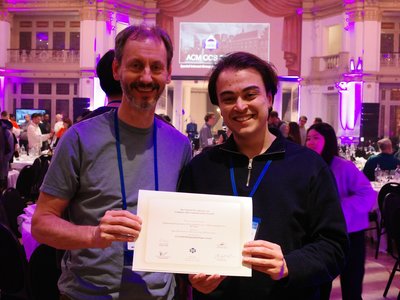
Marten van Dijk and PhD student Murat Bilgehan Ertan (both CWI & VU) received a Distinguished Paper Award at ACM CCS 2026 in The Hague, November 2026.

Understanding trade-offs

Importantly, the findings do not mean that privacy-preserving training of machine learning models is impossible. Rather, they reveal fundamental limitations of DP-SGD under standard worst-case privacy assumptions. By making these limitations explicit, the research provides a better basis for assessing the privacy and accuracy trade-offs involved in developing machine-learning systems that are trained on sensitive data.

Computer Security at CWI

Marten van Dijk leads CWI's Computer Security group and is an endowed professor in Secure and Intelligent Computing at Vrije Universiteit Amsterdam. Murat Bilgehan Ertan is a PhD student in the Computer Security group at CWI and is also affiliated with Vrije Universiteit Amsterdam. The CWI group studies how to build secure computing environments, including secure machine-learning systems, using formal methods and cryptographic proofs.

More information

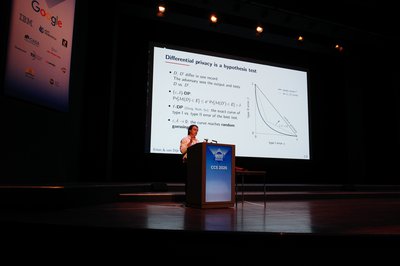
PhD student Murat Bilgehan Ertan (CWI & VU) speaking at ACM CCS 2026 in The Hague, November 2026.