Thanks to current developments in social media, people can remotely share their experiences, regardless of their place in the world. An important requirement is the synchronization of media, such as movies and games. Ishan Vaishnavi, PhD student from the Centrum Wiskunde & Informatica (CWI) in Amsterdam, studied network factors that affect shared experiences, such as time synchronization. On 24 June he received his PhD degree from the Vrije Universiteit Amsterdam for his dissertation ‘Coherence in Synchronous Shared Experiences’. His research can be applied to the design of the future internet – in particular to remote social communication. His results have been used as an input for a new draft standard of the international Internet Engineering Task Force IETF
Football
When friends on different locations in the world view a football match together and communicate on it using Skype or Facebook, it is important that their communication and the content is synchronized – otherwise one of them can shout “Goal!” while the others have not seen it yet. This can lead to irritation. As servers that broadcast the movies cannot be influenced, adjustments must be made on the client-side to synchronize the signals. Vaishnavi designed a mechanism to do so. He also did user studies, together with the KU Leuven (Belgium), to find the maximum delay that users do not experience as disturbing. This proved to be one second - much longer than the 150 ms which people considered before. This offers new perspectives for the problems that application designers encounter.
Future Internet
Massive use of multimedia and 3D applications will affect the performance of the Internet in the future. It is therefore important that bandwidth is used efficiently. Vaishnavi looked at the transfer of shared experiences to other platforms, such as mobile phones and iPads – convenient when users leave their houses. Currently, the video signal, chat sessions and advertisements are transferred one by one – as if, during a move, every piece of furniture is transported one by one, rather than all at once in a large moving van. The CWI researcher developed techniques that make it possible to easily switch platforms. He has also developed techniques for the future internet to improve the Quality of Service (QoS) of the network. This research is part of Software as Service, one of the important research areas of CWI.
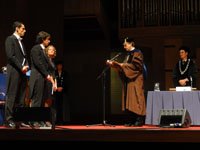
PhD ceremony of Ishan Vaishnavi (2nd left) at VU University. Picture: Steven Pemberton.
More information:
The project was funded by the EU iNEM4U project, the BRICKS program and the TA2 project. Thesis: http://dare.ubvu.vu.nl/handle/1871/19782. The study was conducted in the Distributed Interactive Systems (SEN5) research group at CWI. Supervisor: Prof. dr. D.C.A. Bulterman (CWI and VU) and Prof. dr. ir. M.R. van Steen (VU). Picture: part of Ishan Vaishnavi's thesis cover.
